
When Political Outrage Becomes a Reckless Religion
Some plagues don’t spread by blood or breath. They spread doggedly through a belief system.
From the bizarre dance rituals of the eighteenth-century Shakers to today’s synchronized social-media chants and marches, the old hunger to belong still drives us to worship through radical acts of devoted frenzy.
Like the early Shakers, people are fleeing chaos by joining cliques that develop a retinue of clichés and tropes.
“Defend democracy.” “Stop the steal.” “Anti-Fascist.” “Make America Great Again.”
Each slogan is a password claiming worthiness while proving the opposite — a verbal handshake at the cathedral door with fingers crossed. The emotional choreography is identical; only the symbols have changed
Behind the chants and protest marches, that same ancient fear … that same survival motive:
If I don’t believe and belong, then I won’t survive for long.
FOMO — Fear of Missing Out
It has become an invisible whip. Once confined to the stock market, it now drives frantic social allegiance.
We obey the tribe, perform our savage ritual dance, and repeat threatening defilements to invoke our victim’s conversion by fear and trembling. It’s the choreographed exorcism shuffle of the Shakers, chanting “Devil be gone!”, but in media lockstep — a ritual as old as religion itself, attempting to prove devotion and belonging.
Politics has morphed into a pretend religion. The same fanatic mechanism that once produced Shaker religious revivals through mass hypnosis in the 1840s now animates our political behavior. Shunning has always been the most economical and effective form of group control. The Puritans, Quakers, Shakers did it, and the Amish, Jehovah’s Witnesses, and Scientologists still do. Social media has perfected it by digital excommunication.
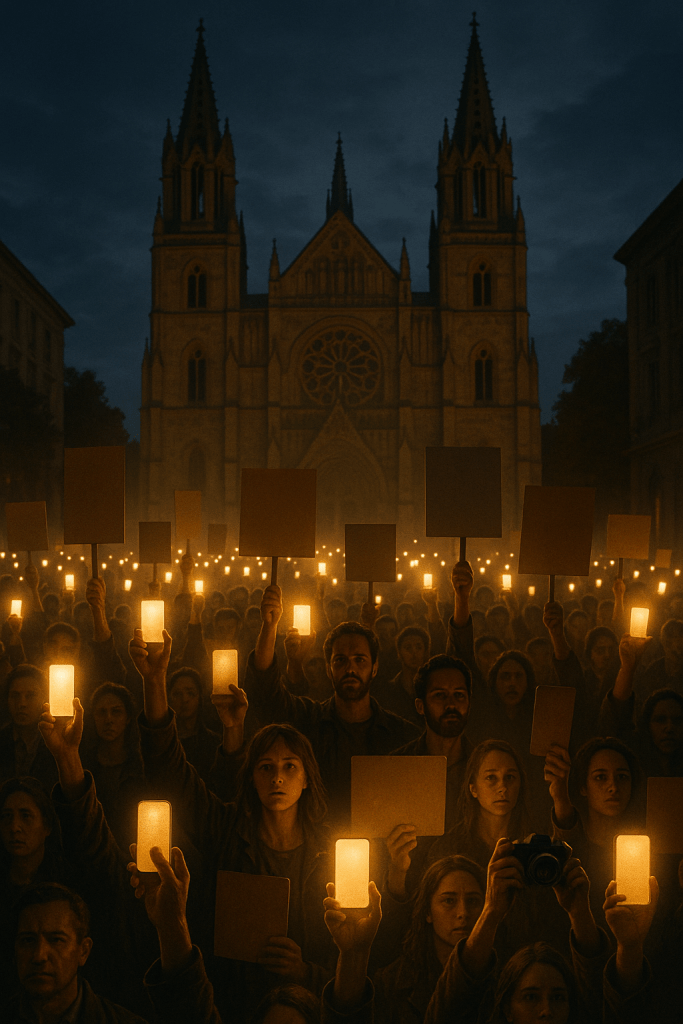
When Political Outrage Becomes a Fanatic Religion
Unfriending, doxxing, and cancelling: these are the new media exorcisms and pundit Fatwas.
Each whispers: You are no longer seen; you no longer exist in my world.
For social animals — including us glorified naked apes — tribal shunning is unbearable.
So we obey the dominant tribal sentiment, repeating its commandments until conscience falls silent.
The Puritan Reflex
Every age invents its witch trials and contrives shallow evidence to appease its guilt-ridden conscience.
We no longer hang bodies to leave them swinging in the wind; we strangle our enemy’s reputation instead.
Character assassination replaces the gallows; trivial impeachments and petty indictments clutter the courts.
Where burning at the stake once purified heretics, we now stage a mass firing of bureaucratic blasphemers.
Whether Democrat or Republican, a plague upon both houses.
We call it justice, but it’s vengeful theater — an attempt at exorcism of our own unacknowledged wickedness.
The harder we hunt for evil out there in the swamp, the more it seeps from deep within our unkempt souls.
We are purging mirrored reflections of our personal evils and devils — and yet remain totally unaware of it.
From John Brown to the Present
The Shakers might be seen as the first traumatic shock of grace to strike the young republic — a spiritual convulsion that shook bodies instead of governments. They danced their redemption into being, trembling to purge sin from their flesh.
A century later, John Brown carried that same fever from the meetinghouse to the gallows. His 1859 hanging at Charlestown, VA. became the spark that ignited the Civil War—the nation’s second convulsion of traumatic grace. He knew it would cost his life to awaken America to the sin of slavery.
Some praised, others reviled him. Whether prophet or provocateur … martyr or murderer … hardly matters; the tragedy showed how blind conviction turns combustible when political outrage turns into reckless religion.
To Abolitionists like Emerson, Thoreau, and Julia Howe, who wrote the Battle Hymn of the Republic, he was
A new breed of saint.
And in our own century, lightning struck again. Charlie Kirk — a polarizing conservative speaker — was shot and killed while addressing a Utah university audience this past September. He was willing to die for his belief. Some praised, and others reviled him. The young killer behaved no differently from an anti-religious zealot.
His assassination was our third traumatic grace, unleashing a cathartic outpouring of guilt across America, disguised as pathos. The bullet that pierced his neck echoed across our divided country like a moral cannon blast, exposing the same rabid fever afflicting us that once triggered the catharsis of our Civil War.
John Brown’s hanging and Charlie Kirk’s assassination … they bookend the same human story: We The People are unable to reckon with our conscience until blood is spilled in sacrificial atonement. Traumatic grace is lightning for the good of fallen humanity and the individual — a violent therapeutic shock meant not to punish, but to heal.
NEWS FLASH: At dusk today, low-flying planes streak across six American states, scattering vaccine-laced bait to halt the spread of rabies among wild animals. https://www.theepochtimes.com/us/usda-is-airdropping-rabies-vaccines-in-6-states-this-month-5929279?ea_src=frontpage&ea_med=section-2news
A Disease like Rabies
Derangement is a disease of the soul — an ideological virus that inflames the human mind until it rages against the world, snarling and biting what it cannot understand. It spreads through digital and personal contact, through slogans repeated until foam gathers at the lips. Friends and family are divided. Once infected, the victim mistakes malice for righteousness and political fury for moral fire.
Its usual cure is agonizing, much like the old series of rabies shots, each dose burning through another layer of self-deception, taking a long time to resolve. Few will volunteer for a therapy that requires weeks of isolation in prayer and fasting, mindful meditations, deep critical thinking, and practicing abstinence from media contact and the infected herd of humanity. It’s the one sure remedy few will endure, for rage is easier than reflection.
And yet sometimes unexpected grace can cure it … perhaps the trauma of a near-death ski accident, a nervous breakdown from academic stress, or the sudden loss of a loved one. Illuminating grace doesn’t flatter; it exposes all our defects, frailties, and corruption. It strikes like lightning in a dark barn, revealing every cobwebbed spider lurking there.
If we survive that lightning bolt of grace, it marks the beginning of sanity — and, if you can bear it, one’s personal sanctity. The fever breaks, our distorted mirror shatters, and we finally get to see who we really are.
A Good Man is Still Hard to Find
Flannery O’Connor—the Southern Catholic writer who shocked readers with violent episodes of grace—showed it in A Good Man Is Hard to Find. A self-righteous grandmother faces her killer, sees their shared humanity, and in that instant is redeemed before death.
John Brown — the fiery abolitionist who came to believe only blood could purge America’s slavery sins — died, swinging on the gallows. Charley Kirk died mid-sentence, marking a turning point in America’s immorality. They both revealed the same law of the soul: grace seldom arrives gently. It comes by a gallow rope, a rifle bullet, or a literary thunderclap by a crippled female author, shattering pretense so truth and compassion can enter.
In our time, the “good man” and “good woman” are still among us, but they are few in number. They don’t chant or rant in lockstep pantomime. They don’t shake and quake in mimicked fear and reverence. They refuse to compromise with the world, then live the Bible as much as possible without making an undue spectacle of it. For they’ve suffered the painful cure, walking among us without a mask over their faces to hide former shame.
When the mob stampedes in its frenzied delirium — heading for the cliff — those few who can see the danger ahead stand aside. Scarred, awake, and merciful, they whisper a prayer for our infected world and wait for that one genuine soul drawn to them who pleads for help. They sadly see the blind leading the blind into the pit.
And in their stillness of soul, they perceive the purpose of civilization — and that helps it survive another day.
***
About the memoir-in-progress, tracing his own Vision Quest from rebellion to revelation, nearing publication:
Path Perilous: My Search for God and the Miraculous
—a spiritual epic for truth-seekers, contemplative mystics, and all who long for God.
Visit www.RMDellOrfanoAuthor.com and share it with others.
 THE TRIQUETRA OF LIFE: Wisdom, Wealth, and Wellness
Leave a comment