Why We Build Monuments to Hide Our Own Devilry
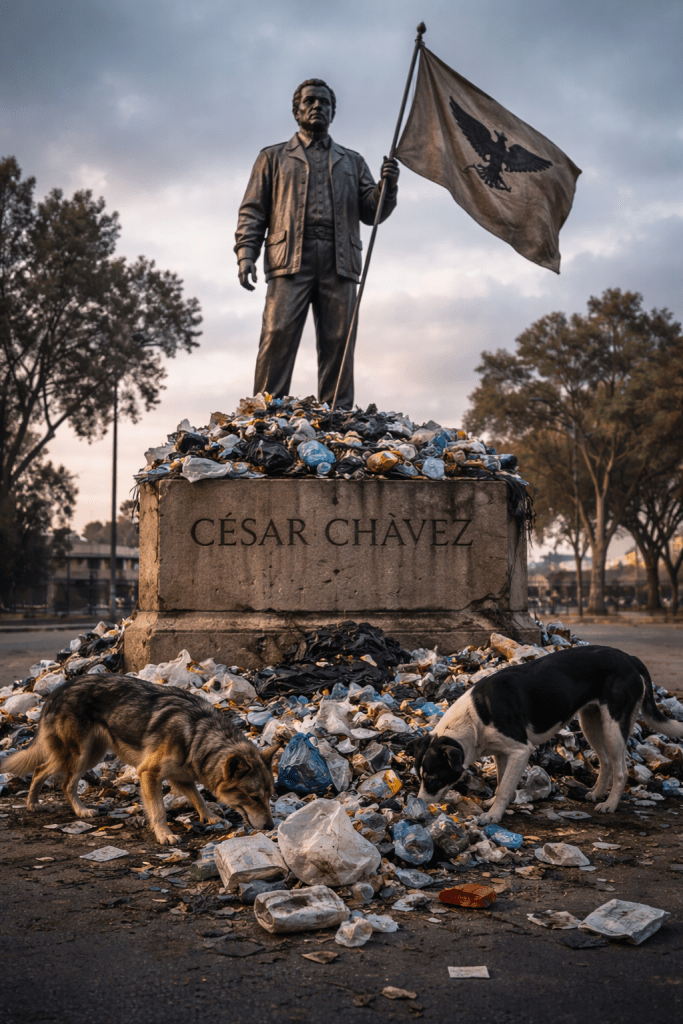
We woke up on March 18, 2026, to a sound less of a “shattering” and more of a “deflating.” It was the sound of a 58-year-old myth losing its air … at last.
For nearly six decades, the name César Chávez was not just a name; it was a secular liturgy—a shorthand for “The Good Fight.” We carved it into street signs, printed it on postage stamps, and taught it to children as the ultimate example of Thoreau’s, Gandhi’s, and King’s militant non-violence. But recent investigations have laid bare that the liturgy was a cover-up for a long-standing, systematic reality of abuse and exploitation of the very people the movement claimed to protect.
The Myth of the Sacrificial Silence
The most haunting part is not just that the abuse happened, but that it was known. Figures within the movement admitted to keeping the truth hidden for almost six decades, believing the “greater good” outweighed the individual lives being broken behind closed doors.
We see this pattern repeat with religious fervor. Take Martin Luther King Jr.—his image carved into the Stone of Hope on the D.C. concourse. To the masses, he is the stainless apostle of the civil rights movement. Yet for decades, we have agreed to sweep his documented private failings under the rug.
Why?
Because a flawed icon is harder to sell than a stone one. We prefer the statue because it doesn’t challenge our inconsistencies. We use these “saints” to compensate for the fact that we still struggle with the very evils they died fighting.
Taxpayer-Funded Penance
The irony is that the public is often asked to foot the bill for this canonization. We spend millions in taxpayer funds on national monuments, civic honors, and hollow holidays. Why are we so eager to fund bronze statues of these “holy” men?
Because the statue acts as a social penance. If we build a monument, we can pretend we’ve solved the systemic problem it represents. If we name a street after a “saint,” we can ignore the “devils” running our institutions. We use these icons to compensate for our own moral failures, purchasing a sense of spiritual progress without doing the hard work of resolution.
The Punctured Icon
The rapid dismantling of these myths is necessary, but it often feels like another form of avoidance. We are quick to tear down the statue because it reminds us of our own gullibility. We hate the “devil” not just for what he did, but for making us look and act like fools for three generations.
Moving Beyond the Pedestal
If there is any lesson in these collapses, it is this: we must stop looking for secular saints to save us. Whenever we elevate a frail human being to an “untouchable icon,” we cast the shadows to hide where abuse thrives.
Social progress isn’t found in “compensation” for a saintly figurehead. It’s found in the messy, un-monumented work of protecting the vulnerable in real time. We don’t need more bronze men with clay feet on pedestals. We need a society that stops compensating its own “devilry” with pretenders of “sainthood.”
Author’s Note:
As I continue final revisions on my manuscript, Path Perilous, these events serve as a grim reminder of the themes I explore: the danger of the “hero” narrative and the peril of the silence that follows. Justice isn’t a cold stone monument; it’s a daily accountability by the living of their social conduct.
If you’d like more insights, visit RMDellOrfanoAuthor.com under the blog category … Politics, where conscience, culture, and spirit intersect.
If you like what you read, please refer this site to others.
 THE TRIQUETRA OF LIFE: Wisdom, Wealth, and Wellness
Leave a comment