
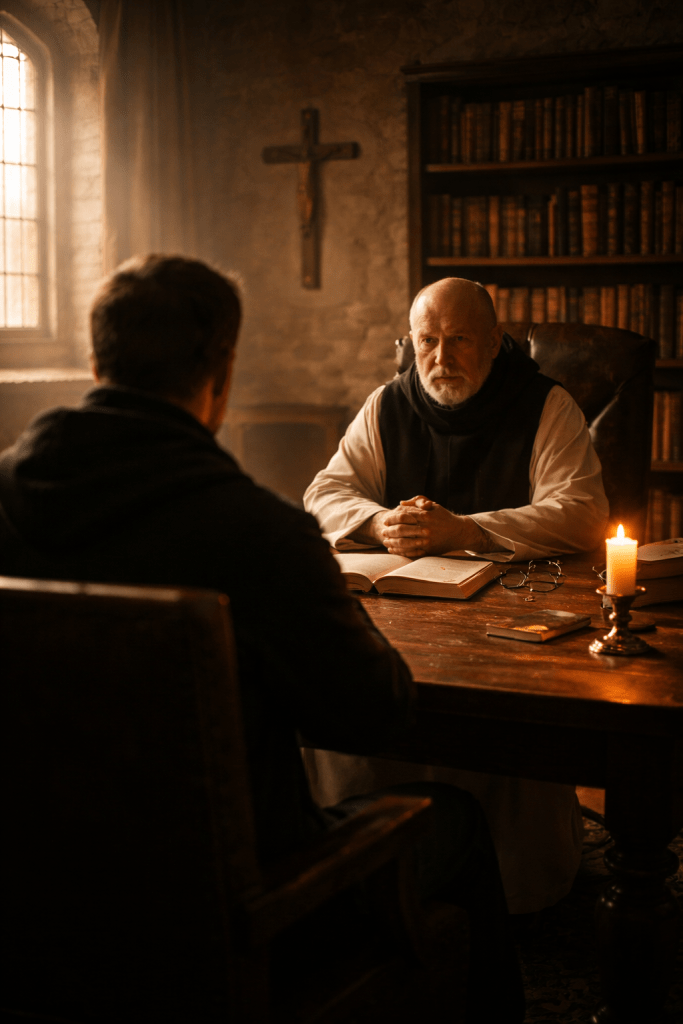
The Abbot sat across from me, hands folded, his inquisitive eyes fixed on me. The silence stretched long enough to force my focus onto what I had come for.
That silence revealed something I had not expected: the Church’s greatest danger would not come from externals, but from what we are no longer able to face within—the judgments and habits we carry with us, the bias we were raised on, and avoid when the room goes quiet.
The Real Threat Your NOR Symposium Missed
Letter to the Editor, April 2026 (Unabridged and Enhanced)
Dear Pieter Vree, Editor in Chief,
Having been encouraged years ago to submit blogs to the New Oxford Review after several of my letters were noted for their clarity—more than 200 of which were subsequently published— I read your December 2025 Symposium issue with close attention:
“The Greatest Threat to the Church”
The contributors named serious concerns—doctrinal instability, technological disruption, demographic change, the Islamic challenge, an out-of-touch hierarchy, clerical feminization, sexual confusion, intellectual weakness, ecclesial misgovernance, ecumenism, and more. Each had merit. Yet taken together, the essays revealed a shared omission.
Nearly every response pointed outward.
Christianity, however, has never been undone by its external enemies. The Church has endured persecutions, heresies, intellectual revolutions, and scandals. It falters not when the world grows hostile, but when its interior life weakens—and divides.
The greatest threat facing the Church today is the erosion of interiority: the diminishing capacity to enter silence, listen for God, confront faults honestly, and undergo genuine interior transformation in union with Christ.
Without this grounding, doctrine hardens into reaction. Media and technology do not merely distract; they shape perception, amplify agitation, and reward surface response over depth. Without an interior anchor, the believer is carried along.
Without growth in holiness, pettiness and confusion take hold.
I write this not as theory, but from experience. Years ago, at St. Joseph’s Abbey in Spencer, Massachusetts, I met privately on several occasions with Fr. Thomas Keating, OCSO, a cofounder of Contemplative Outreach, whose life was devoted to silence and interior prayer. I saw how such practices form Christians who are grounded rather than anxious, discerning rather than reactive, charitable rather than ideological.
I still recall his understated remark:
“We need all the help we can get.”
He was not speaking of external threats, but of the urgent need to restore the Church’s interior life.
Long before formal churches were built, early Christians gathered in small, quiet houses—places where believers prayed, listened, and learned to discern the movements of the heart. These house chapels formed Christian identity before ecclesial structures and hierarchies took shape.
Every authentic reform in the Church’s history began in deep prayer. And every reformed religious order that abandoned its interior life eventually failed.
That is why the greatest threat to Christianity is not the many windmills identified in the symposium, but the diminishing depth of its inner life—the eye of the needle where every authentic thread of repair must pass.
Without that silence, we remain as I once was—sitting across from him, unable to face what we have come for.
Respectfully,
Richard M. Dell’Orfano
 THE TRIQUETRA OF LIFE: Wisdom, Wealth, and Wellness
Leave a comment