The Ancient Essenes had a series of pools they used for purifying themselves, especially after handling diseases leading to death or the various issues for child birth. Jesus’s baptism in the Jordan by John the Baptist symbolized the need for a behavioral transformation to achieve spiritual rebirth or metanoia. The Baptists and Mormons place great emphasis on an adult believer’s water immersion to symbolize this state of grace, s do the Anabaptists: the Amish, Bruderhof, and Mennonites. Catholics and Lutherans use a water ritual for infant and adult baptisms.
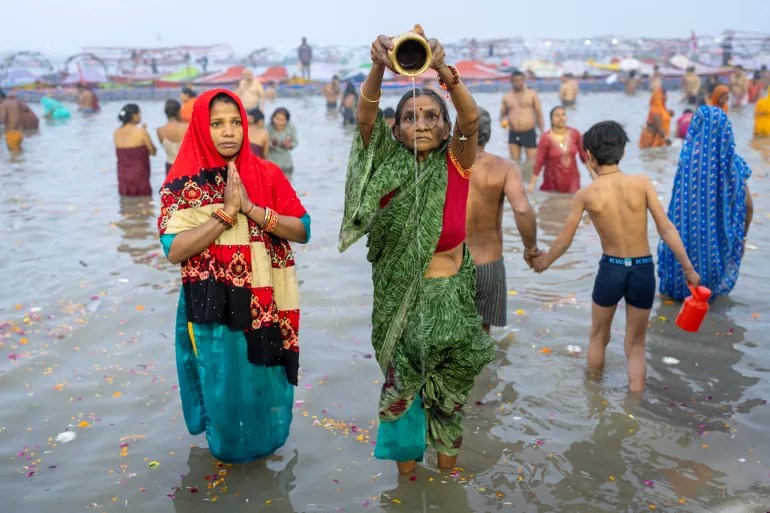
The Hindus, 15 million of them, sought absolution from their sins in the freezing waters of the Ganges, bathing to remove their sins. However sincere these practices appear, the famous Catholic author Flannery O’Connor wrote short stories that imparted a drastically different perspective regarding the grace of absolution. Hers didn’t require water in a ritual. In Flannery O’Connor’s perspective, this would be illusory, for true absolution is an unearned grace that strikes unexpectedly, sometimes violently in a shake down. “The violent are taking heaven by storm” (cf. Matt 11:12).This is difficult for many to endure for long, since the only path that leads to heaven is thorny, steep, and narrow indeed.
Here’s Chat GPT expressing Flannery’s perspective:
“Flannery O’Connor, a devout Catholic and a writer deeply concerned with themes of grace, sin, and redemption, would likely view the Hindu practice of bathing in the Ganges as symbolic but ultimately insufficient for true absolution. In her work, O’Connor often emphasizes the idea that grace is not something one can earn through ritual or self-effort. Rather, grace is a gift—unearned, unpredictable, and often disruptive.
For O’Connor, absolution comes not through human action but through the intervention of God, who offers grace in unexpected and sometimes violent ways. Her characters frequently undergo a spiritual awakening, or metanoia, which is often painful, jarring, and involves a profound shift in their understanding of themselves and their relationship with God.
This transformation is not a smooth or gentle process but a difficult one, as the path to redemption is “thorny, steep, and narrow.” In contrast to the Hindu ritual of purifying oneself through physical acts, O’Connor would likely argue that true absolution can only come through a divine encounter that requires submission to God’s will and recognition of one’s own fallen nature. For O’Connor, the Ganges might wash away physical dirt, but it cannot cleanse the soul—only the grace of God can do that, often through a difficult and transformative experience.
Her perspective is rooted in the Christian understanding that salvation and redemption are not human achievements but gifts of God’s grace, offered even to those who may not deserve it or understand it at the time.”
Pope Francis stating that “all religions lead to God” is misleading and confusing. True, the Hindus or Muslim who undergoes such a drastic character transformation, . . . and perseveres in a life of purity . . . can find God. Mahatma Ghandi comes to mind. On the other hand, the cradle Catholic who does not follow through after a laborious spiritual rebirth can fall short of God. “He who perseveres to the end will be saved (cf. Matt 24:13).” Religions of all stripes are like a game of “Clue” with rituals and directives to solve the labyrinth of the Flesh.
Do all religions equally lead to God? In a limited sense, yes. However, there’s a final leap of faith for absolution, and in my opinion, the example of Christ crucified provides needed courage — hanging at the end of our rope. No one should idolize any brand of religion, because rituals can take you only so far, not one step beyond the threshold of an inward Holy Door — Vatican-symbolized as the crucial passageway to salvation within all men.
“Ye must be born again.” John 3:7
“When a woman is in labor, she is in anguish because her hour has arrived; but when she has given birth to a child, she no longer remembers the pain because of her joy that a dhild has been born into the world.”
John 16:21


 THE TRIQUETRA OF LIFE: Wisdom, Wealth, and Wellness
Leave a comment