
An Excerpt from Chapter Twenty-Seven
Path Perilous: My Search for God and the Miraculous
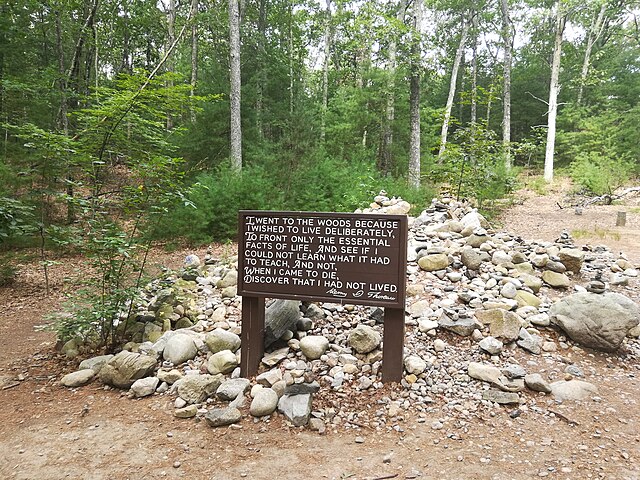
In the 1960s, hitchhiking was common and fairly easy, so I thumbed my way to Concord to see, firsthand, Henry David Thoreau’s cottage on Ralph Waldo Emerson’s land. Their transcendentalist writings carried a mystique that drew me there. Lacking money for Concord’s tourist attractions, I walked through the town and circled Walden Pond
on foot. My hippie appearance stopped conversations short, and people stared openly. Full beards were ordinary in the 1840s, but in these troubled times, they marked me as an intruder.
Emerson, the transcendental philosopher, had hired Thoreau to tutor his children, and part of the arrangement included the use of Emerson’s forested land on the north side of Walden Pond. Thoreau lived and wrote there for two years, in a ten-by-fifteen-foot cabin, he’d built for a mere twenty-eight dollars.
He had grown weary of the tedium of his father’s pencil-making business. I, too, was repulsed by my father’s marine-contracting work. Sitting inside Thoreau’s replica cabin, I felt a deep kinship with his longing to escape the rat race and its workaholic demands.
In his meditations, Thoreau spent as much time exploring his inner nature as the outdoors. He wrote words in Walden that haunted me:
“Heaven is under our feet as well as over our heads.”
Another of his famous sayings—“Most men live lives of quiet desperation”—pressed me to look beneath the surface of life, to ferret out the deeper meaning of its drama, and to find my role in its unfolding script, no matter the risk or anguish to my soul. That search helped dispel the despair that clung to my uncertain future.
Emerson, being a Harvard graduate and Thoreau’s mentor, once remarked that Harvard taught most of the branches of worldly learning. Thoreau, also a graduate of the same institution, replied, “Yes, indeed—all the branches and none of the roots.”
On my first reading of this statement, I hadn’t grasped its meaning. But after my own encounters with Harvard and MIT students—many hanging, apelike, from the academic branches of materialism—I finally understood Thoreau’s point. They clung to the branches while ignoring the unseen roots of life. Colleges, for all their pampering and insulation, distract their students from exploring life at its depth. I could now see why Thoreau’s vision cut deeper than Emerson’s.
While touring Walden, I was unaware that a Black minister, Martin Luther King, Jr., had just delivered a searing speech condemning America’s war in Vietnam. His message reached far beyond racial injustice, challenging the nation’s moral foundations. I was too immersed in my own struggle for survival to pay much attention at the time, but when I later read his critique of U.S. policy, I felt we were on the same wavelength.
Profiles in courage were scarce, and I aspired to match the stature of this heroic man. My soul longed to stand tall, even as it remained shackled to the cowardice of my flesh. We were both struggling against the fear of death, pressing forward in service of our visions and dreams.
When dusk settled in, I began to look for a place to sleep, perhaps under a bridge or in a shed, as circumstances allowed. Trusting in Almighty Providence, I felt like a little child again, walking beside his father, my small hand wrapping tightly around his thumb.
From the memoir-in-progress, nearing publication:
Path Perilous: My Search for God and the Miraculous
—a spiritual epic for truth-seekers, contemplative mystics, and all who long for God.
Visit www.RMDellOrfanoAuthor.com and pass it forward.


Leave a comment