An Excerpt from Chapter Thirty–Eight
Path Perilous: My Search for God and the Miraculous
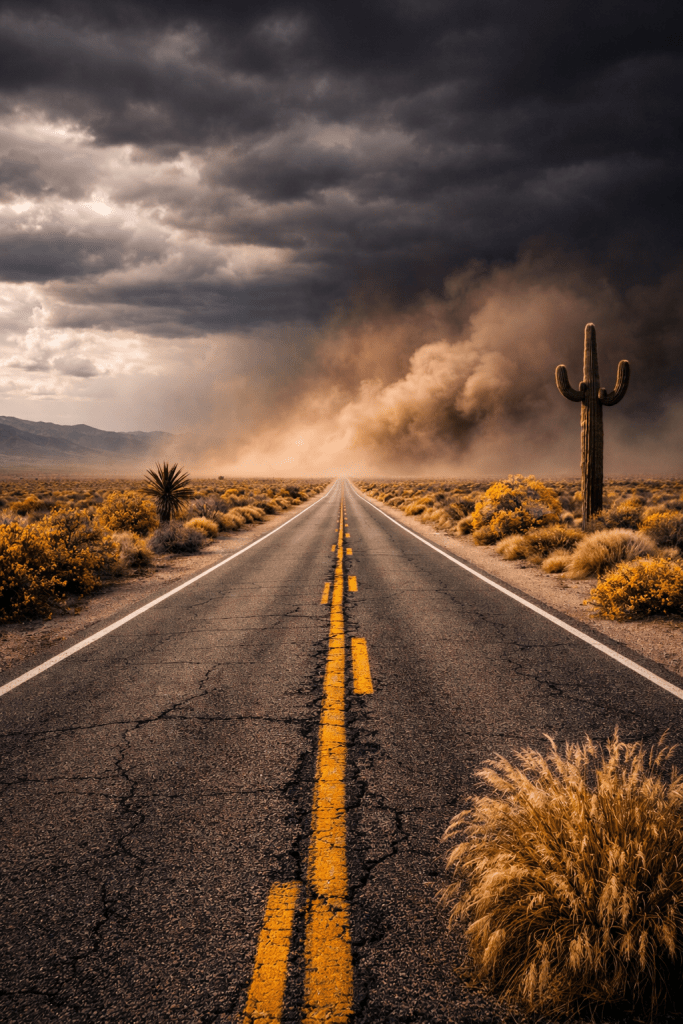
Driving through Albuquerque, we finally turned south. The city outskirts weren’t much to speak of—rows of rundown hovels where poor Navajo and Hispanic families eked out a living. Rusting cars littered the yards, and freshly washed garments and towels hung from clotheslines, snapping in the dry wind. We passed a gas station where a young native woman sat at a folding table displaying silver and turquoise jewelry. The landscape turned barren, the air thinning into heat and dust.
A dust storm slowed us down, grit ticking against the windshield, the road fading ahead until we could barely see our way—just a few yards at a time.
After three hours of driving, hardly speaking, the hum of tires steady and the cab warming around us, Fred said, “I thought you’d like to know a little history of where we’re passing through. This stretch is called Jornada del Muerto—the journey of death—because people died of thirst or from the Apache raids. Your attempt to hitchhike across it would have been fatal.”
He indicated with his left thumb. “About forty miles northeast of here—that’s where the first atomic bomb was tested at Trinity.[i]”
Foxtail grass, creosote bush, yucca, and tall Cereus cacti slid past the windows, the glare off the sand stinging my eyes. Two antelope paced us for a few seconds, hooves flashing, then broke away and vanished into a drifting, swirling cloud of dust—as if they’d never been.
“How’d it get that name?” I asked.
“Oppenheimer,” Fred said. “Head scientist. He was into Hinduism—with its trinity of Brahma, Vishnu, and Shiva. When the bomb went off, he quoted Vishnu from the Bhagavad Gita: ‘Now I am become Death, the Destroyer of worlds.’”
“John the Evangelist, in Revelation,[ii] writes that a third of mankind is destroyed in a fiery flash. Maybe that’s nuclear war—Armageddon.”
“It might be,” Fred said, thumping my knee. “Christianity doesn’t own doomsday. But back to your Padre Pio—how will the Catholic Church make him a saint?”
“It doesn’t make saints,” I said. “It canonizes them after a thorough investigation. In two thousand years, the Church has recorded more than ten thousand saints.”
“The Bible says Jesus, Peter, and Paul raised the dead—but did they?”
“Church history claims more than four hundred saints did the same.”
“Is that so? Where’s the proof?”
“Sts. Vincent Ferrer and Francis de Paula[iii] were powerful fifteenth-century wonder workers. John Vianney[iv] of France—nineteenth century—could read minds like Padre Pio.”
“How did you get all that into your head?”
“I spent months studying Butler’s Lives of the Saints. Four thick volumes.”
“Probably fiction. Makes me wonder if any of it happened,” he said.
“Likely because you weren’t there to see them,” I said.
[i] The Trinity Atomic test site was named circa 1944, possibly by J. Robert Oppenheimer, administrator of the first atomic testing grounds, He remarked later that it brought to mind words from the Bhagavad Gita: “Now I am become Death, the destroyer of worlds.”
[ii] Revelation 8-10, “The Seven Trumpets, The first angel blew his trumpet, and there came hail and fire, mixed with blood, and they were hurled to the earth, and a third of the earth was burned up, and a third of trees were burned up, and all green grass was burned up…, The second angel blew his trumpet, and something like a great mountain, burning with fire, was thrown into the sea, and a third of all living creatures in the sea died, et al … By these … a third of humankind was killed, by the fire and smoke and sulfur coming out ….” See also Ezekiel 38 & 39 and Rev, 9:16.
[iii] St Vincent Ferrer, Spanish d,1419, age 69, could preach and be heard for miles and understood in several languages at once.
St Francis de Paula, French, d, 1507, age 91, had an extraordinary gift of prophecy: thus he foretold the capture of Otranto by the Turks in 1480, and its subsequent recovery by the King of Naples. He was gifted with discernment of consciences,and was no respecter of persons, whatever rank or position. He rebuked the King of Naples for his ill-doing and suffered much persecution.
[iv] St John Vianney, 1786-1859, grew in fame by healings, conversions, readings of men’s deepest thoughts, and living a life of extreme austerity while a priest of Ars, France, The Cure d’Ars, by Abbe Francois Trochu, Tan Books, (C) 1927.
From the memoir-in-progress, nearing publication:
Path Perilous: My Search for God and the Miraculous
—a spiritual epic for truth-seekers, contemplative mystics, and all who long for God.
Visit www.RMDellOrfanoAuthor.com and pass it forward.
 THE TRIQUETRA OF LIFE: Wisdom, Wealth, and Wellness
Leave a comment