
Every generation builds its own version of a bunker bomb shelter. But sooner or later, every physical refuge reveals its limitations.
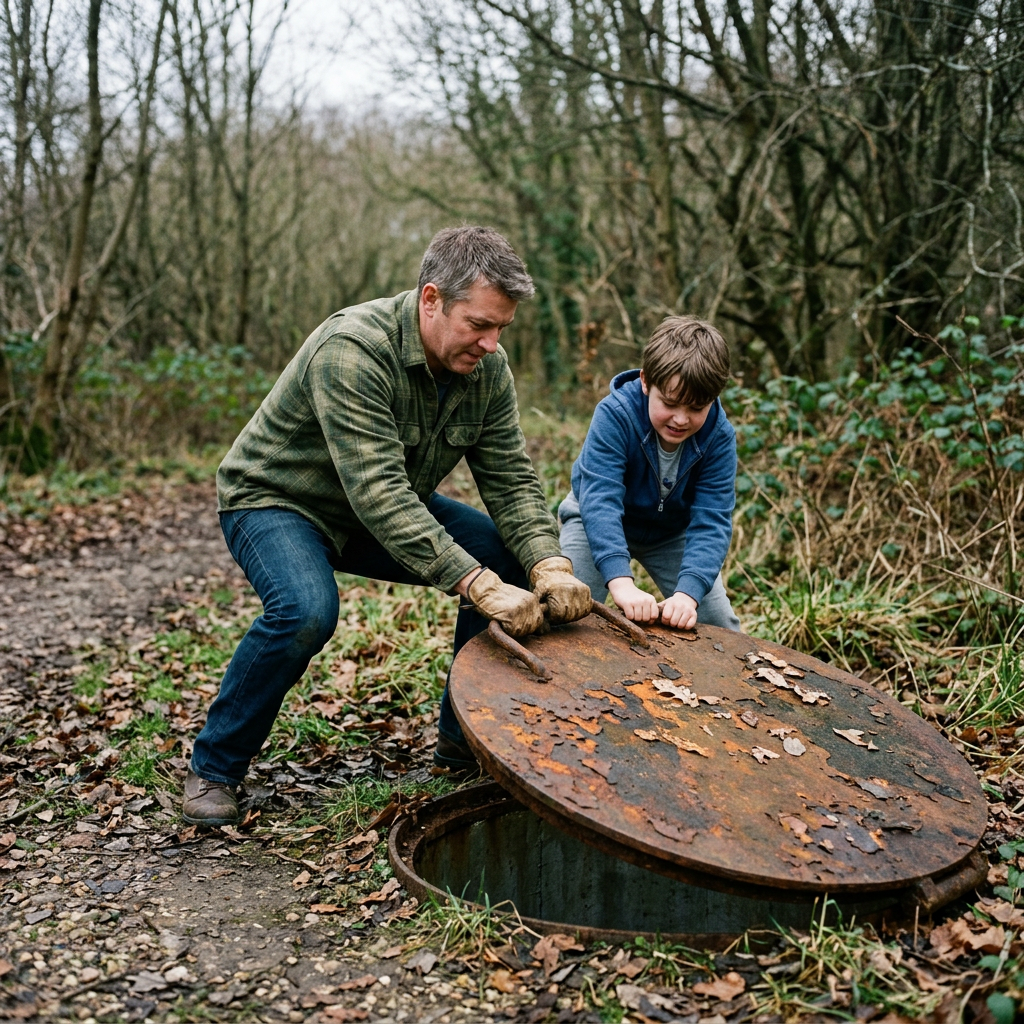
In 1776, it was a stockade against the coming Redcoats; in the 1950s, a fallout shelter against Soviet missiles. The form changes, but the psychology does not. Both respond to the same ancient fear: “How do I protect myself from uncertainty, loss, suffering, and death?”
In 1953, when I was eleven years old, I walked home from elementary school through the suburban streets of Melrose, northeast of Boston, discussing bomb shelters with my friends. “Your dad’s building one?” The Soviet Union had the atomic bomb. America now had the hydrogen bomb. We schoolchildren practiced “Duck and Cover” drills beneath our desks.
Newspapers carried photographs of mushroom clouds towering miles into the sky. We did not understand the science, but we understood enough to be terrified. On the walk home, we planned our escapes. We imagined basement bunkers where danger and death could not penetrate—little boys trying to out-engineer the apocalypse.
Seventy-three years later, I find myself reading about billionaires purchasing remote estates in Hawaii, New Zealand, and Argentina. Some have reportedly invested hundreds of millions of dollars in compounds equipped with underground shelters, independent fresh water supplies, agricultural systems, backup generators, communications networks, and “trusted” private security guards.
As I read these stories, I experience a strange sense of déjà vu. The schoolboys of 1953 had nothing but imagination. The billionaires of 2026, still little boys at heart, have unlimited capital.
Yet both are engaged in the exact same search.
We imagined backyard holes hiding beneath a mushroom cloud; they build billion-dollar fortresses shrouded beneath the exact same sky.
What fascinates me is not the expense but the myopic strategy. The billionaire bunkers assume that enough concrete, advanced technology, planning, and U.S. dollars can establish a safe boundary between them and catastrophe. It assumes the threat is local—not global—and that survival can be secured by moving great distances elsewhere.
Yet every communications system, every satellite link, every intelligence feed, and every security network reveals the opposite. The bunker builder has not escaped civilization; he remains connected to it by a thousand threads. The blast door closes, but the antenna rises because total isolation is intolerable.
The shelter promises independence, but delivers an expensive prison.
I cannot help recalling Nevil Shute’s novel On the Beach. After a nuclear war destroys the Northern Hemisphere, the citizens of Australia wait as radioactive air masses slowly drift southward around the globe. There is no enemy left alive to fight, no border left to cross, and no refuge left to seek. The cloud keeps coming.
That image has stayed with me for decades. The billionaire studies a map and sees sovereign borders in Hawaii, Argentina, or New Zealand. The atmosphere sees no borders at all. The cloud recognizes no property lines, no blast doors, and no net worth. It simply drifts where the wind blows.
The tragedy is not that the billionaire built a bunker. The real tragedy is that after a lifetime of extraordinary success, intelligence, discipline, and achievement, he is still placing his false hopes in essentially the same physical solution that occurred to an eleven-year-old boy.
The bomb shelter budget is larger. The engineering is more sophisticated. Yet the temporal solution remains unchanged. Faced with profound uncertainty, build a wall. Faced with vulnerability, construct a secret refuge somewhere. The years pass, the boy grows old, but his illusory solution remains.
Faced with mortality, find a safe hiding place.
I do not write this to ridicule billionaires. I understand them. Every human being longs for something enduring. We long for security from a lifetime of uncertainty and permanence in a world of constant change. The search itself is not misguided. The mistake lies in believing that what is enduring can be secured through temporal means.
Concrete, steel, distance, technology, and money can prolong survival, but they cannot provide the final permanence for which the human heart aches. What troubles me is not the effort, but the folly that after a lifetime of searching, a man still believes the answer lies behind another door.
The lesson I have slowly learned is that the enduring refuge is not geographical, political, technological, or financial. It is spiritual. The real question is not whether we can find a place where suffering and death cannot reach us. The real question is whether we can discover an everlasting survival within ourselves that remains intact when mortality reaches us. That is the vital journey that interests me now.
The boys discussing bomb shelters, the billionaires building bunkers, and the aging memoirist typing quietly at his desk are all searching for the same permanence. But this old man suspects it cannot be purchased, engineered, or located behind a blast door.
Published by the New Oxford Review, a conservative Roman Catholic peridodical
Richard M. DellOrfano spent ten years on a cross-country pilgrimage following Christ’s instruction to minister without possessions. He is completing his autobiography: Path Perilous, My Search for God and the Miraculous.
 THE TRIQUETRA OF LIFE: Wisdom, Wealth, and Wellness
Leave a comment