
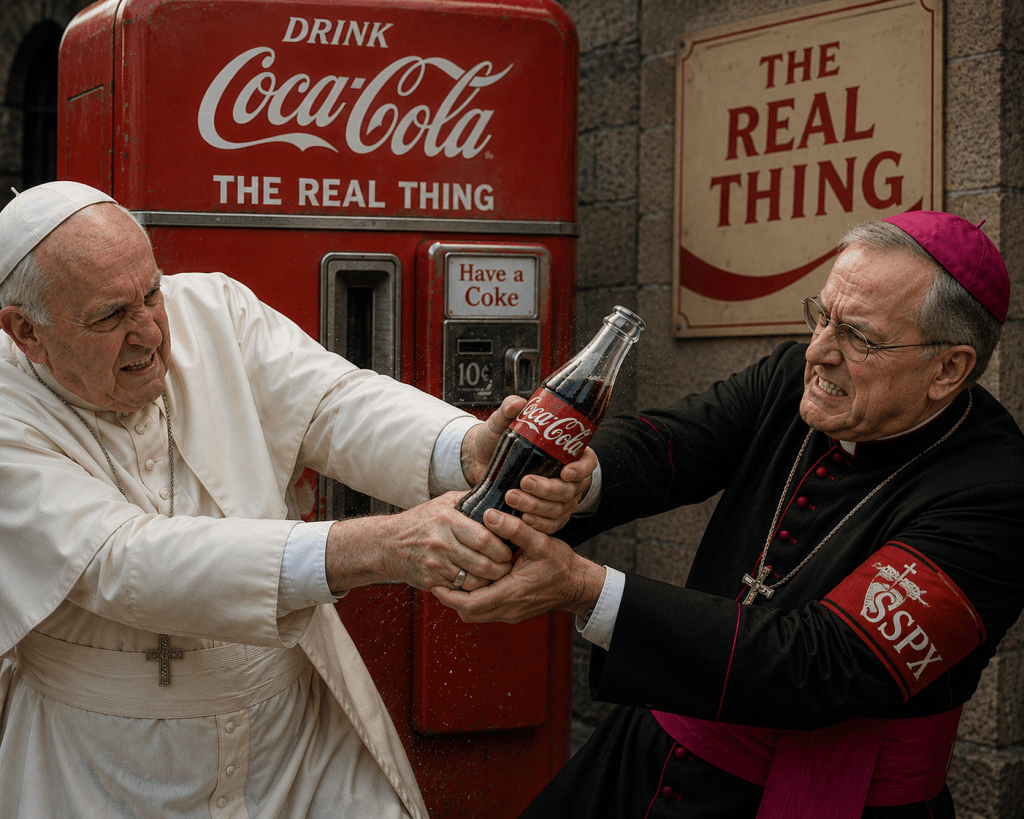
There was a time when authenticity didn’t need a 26-page manual to explain itself.
On a sweaty Saturday morning of my youth in East Boston during the 1950s, I escaped my father’s shop at lunchtime. The relentless morning chores and heavy summer humidity quickened my pace to Luigi’s local grocery store. Pulling open the weighted screen door, I caught the luscious aroma of Italian cold cuts, basil and oregano seasonings, fresh-cut tomatoes, onions, and savory green peppers. My stomach growled. At the counter, I ordered Luigi’s special: a crusty “spuckie.” Then I lifted the lid on a cooler and pulled out a frosty Coke.
The relief was simple: a satisfying meal loaded with cold cuts that bled greasy juice into the butcher paper, paired with an ice-cold, sweating can of classic Coca-Cola. When you popped that aluminum tab and took a drag, you didn’t need a synodal boardroom sign-off, an academic analysis of high-fructose percentages, or a legal certification to tell you it was Coca-Cola. It hit the spot because it felt alive, tingling, unpretentious, and completely grounded in a gritty reality anyone could taste.
*
Today, if you look at the grand ecclesiastical war games between the Vatican and the Society of Saint Pius X (SSPX) ahead of their July 1 breaking point at Écône, you realize the exhausted modern Catholic consumer is being forced to choose between two different but equally imitative beverages.
First, you have Corporate Headquarters in Rome. The modern Vatican owns the historic trademark and the global factories of its previously addictive brew. But more than a century ago, like Coca-Cola panicking over cocaine issues, the Church abandoned the equivalent of coca-leaf extract in its homilies: the one ingredient that lent a sermon its distinctive vitality. Further changes for the changing popular market at Vatican II, culminating by 1970, diluted the original formula even more.
Its Coca-Light left everyday believers with a flat, mass-marketed corporate compromise that had lost its original ability to elevate every soul taking “the pause that refreshes.”
Then you have the SSPX—the rogue regional bottler. They saw the corporate betrayal, locked themselves inside a defensive fortress, and set up a hyper-purist laboratory to reverse-engineer the classic brew. They gathered the exact chemical list of ingredients down to a science: flawless Latin grammar, mitre and lace, and the 1962 TLM rubrics, all tightly tied to rigid, uncompromising discipline. They filled their bottles, slapped “Classic” labels on them, and marketed them from the ramparts, claiming they alone possessed the classic, traditional, original recipe.
But here’s the irony of this fifty-year antagonism: both use decocainized leaves. Neither merchant produces and sells to Catholics the potent original formulation.
When Coca-Cola stripped the active narcotic from its recipe in 1903, it kept the spent, dry fiber of the coca leaf for flavor, but left the real kick behind. The SSPX has done much the same thing. It has meticulously preserved the dry, structural fiber of ritual tradition and produced a formula without any actual coca—not to equate that drug stimulant with its counterpart, sanctifying grace.
As Superior General Davide Pagliarani prepares his pen to cross the final canonical boundary on July 1 by elucidating his legal contentions against the explicit orders of Rome, the world is watching a boardroom turf war over a trademark beverage. One side offers a corporate dilution. The other offers a convincing imitation of the original.
The missing active ingredient that can lift our spiritual life—divine contemplation—is not to be found in a Vatican decree or a 26-page legal brief from an SSPX legalist.
Neither merchant is handing a thirsty soul “the pause that refreshes” on a stifling Saturday in a neighborhood delicatessen. The Real Thing was phased out long ago.
“Woe to you experts in the law, because you have taken away the key to knowledge. You yourselves have not entered, and you have hindered those who were entering.” (Luke 11:52)
 THE TRIQUETRA OF LIFE: Wisdom, Wealth, and Wellness
Leave a comment