The Basilica de la Sacrada Famila in Barcelona
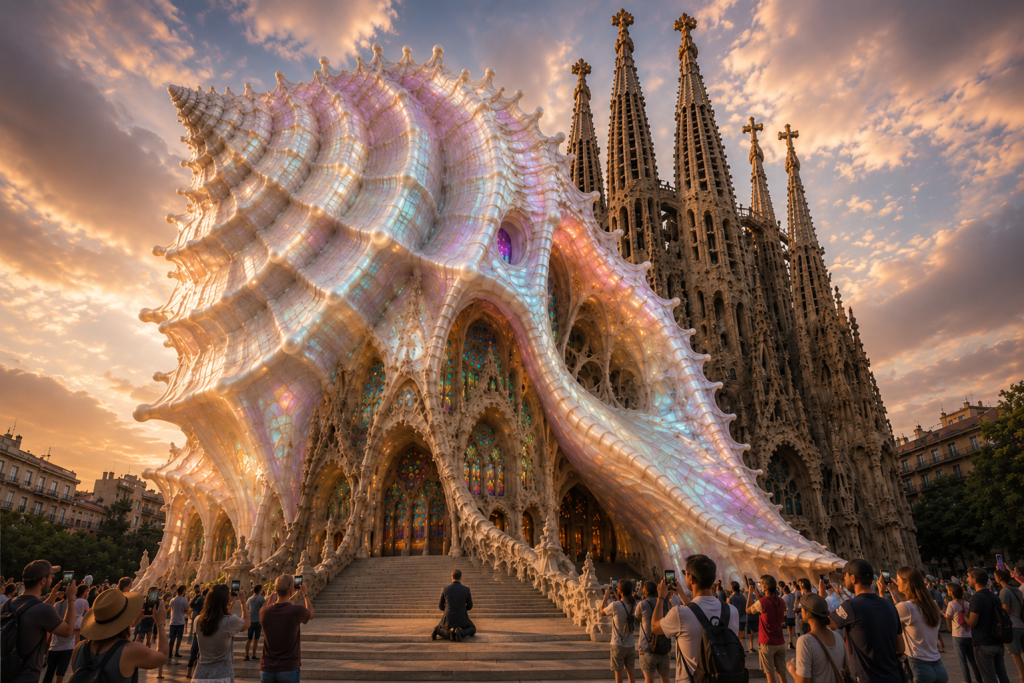
My brother recently sent a collection of photos from his tour of the Basílica de la Sagrada Família in Barcelona. The images were striking, capturing a staggering arrangement of grandiose concrete designs and soaring, tree-like columns, radiant in vibrant, colored glass filtering the Mediterranean sun. It is an engineering marvel, undoubtedly beautiful to behold as an artistic and structural feat.
Yet, looking closely at his snapshots filled with a crowded mass of shuffling tourists, left me with a distinct and unsettling impression: the building functions effectively as a magnificently beautiful conch shell. The architecture is overwhelmingly grand, but it seemed entirely empty of the quiet reverence that defines a true sanctuary.
What I see is overt prosperity requiring a purge of the Church. Radical reform by faithful stewards every few hundred years systematically drags it back to sanity. When the visible architecture of the Faith becomes a loud, theatrical spectacle designed to cater to a global tourist circuit rather than offer shelter to the humble penitent, it serves as a warning sign. It gives glaring evidence that clerical egos, sensational populism, and commercial interests have once again overwhelmed the Church’s prime directive and eternal purpose, drifting the institution from its safe-haven anchorage toward worldly compromise. This slippage toward outward exuberance and inward decay is an ancient, recurring cycle.
In the early eleventh century, the Western Church faced an existential crisis of identity that threatened to dissolve its spiritual authority entirely. Worldly corruption had thoroughly infiltrated its highest ranks, turning the administration of grace into a corporate enterprise. Simony—the literal buying and selling of ecclesiastical offices and holy goods—had clearly transformed spiritual leadership into a lucrative commodity for ambitious nobles. Clerical unchastity and concubinage were rampant, severely diluting the moral authority of the priesthood, while the historic patrimony of the faith was routinely weaponized to fund regional political gains. The institution had become too wealthy, politically muscular, proud, pompous, and hollowed out from within.
The response to this pervasive decay was not a modern compromise with the culture of the day, nor a watering down of standards to appease the masses. Instead, it was a radical, unyielding return to discipline. Orchestrated by St. Odilo from the Abbey of Cluny and strongly supported by Emperor St. Henry, the Cluniac Reforms launched a systematic cleanup across Europe. They confronted the corruption of simony, enforced greater accountability, and revitalized a degraded liturgy. Their focus was restorative rather than innovative, seeking to recover what had been lost rather than invent something new.
Exactly five centuries later, the pendulum swung back toward decay. By the early sixteenth century, structural corruption had returned under a different guise, culminating in Martin Luther’s Protestant Reformation. What began as a fierce reaction against the commercialized sale of indulgences—raising money for the construction of St. Peter’s Basilica in Rome—demonstrated once again that whenever the institutional Church drifts toward earthly grandeur, painful correction eventually follows. The Counter-Reformation became another effort to restore doctrinal clarity and moral discipline. History again demonstrated that the institution cannot drift indefinitely into worldly excess without eventually confronting the consequences.
These are historical signals to our own era, easy to ignore but serving as warning signs along the dangerous ridge road of history. Today the Church’s institutional fabric displays familiar symptoms. We have witnessed the dilution of doctrine, clergy abuse scandals, and shattered trust of the embedded McCormick hierarchy. This has spawned bitter internal conflicts, including the continued tension between Rome and the Society of Saint Pius X that has fractured the unity of the Faithful while the central mission of saving souls risks being overshadowed.
When an institution loses its internal compass, its outward artistic expressions often shift to exuberance as well. Instead of quiet sanctuaries intended for intimate, knee-on-the-floor contemplation, it risks producing theatrical spectacles—grand arrangements of concrete and colored glass that attract the secular world more than the Faithful. Such buildings may become celebrated museums of architecture where visitors loudly praise human designers far more readily than God their Maker. History demonstrates that a beautiful façade cannot mask internal decay indefinitely. A conch shell, no matter how intricately formed or brilliantly illuminated, remains hollow when life inside is withered.
The lesson from Cluniac and Lutheran reformations is that true renewal never comes from catering to the passing whims of the world or focusing on outward showmanship. It requires leaders with the clarity and courage to strip away commercial aggrandizement, confront internal failures honestly, and restore the doctrinal integrity of the Church.
Criticism born of love is very different from criticism born of contempt. The Church has been my spiritual home throughout my life. Precisely because I cherish her divine mission, I cannot remain indifferent when history shows her drifting from the simplicity, humility, and holiness that have so often restored her strength. Ultimately, pointing to the deep fractures within the Church does not show a dislike of the institution, but of the corruption that periodically afflicts it.
The gates of hell have never ceased pressing against Christ’s Church throughout its history. Every generation inherits a responsibility not merely to admire the conch shell but to preserve the Holy Spirit within.
Published by the New Oxford Review, a conservative Roman Catholic peridodical
Richard M. DellOrfano spent ten years on a cross-country pilgrimage following Christ’s instruction to minister without possessions. He is completing his autobiography: Path Perilous, My Search for God and the Miraculous.


Leave a comment