
Podcast Episode: Shipyard Scars at Sixteen — A brief discussion on what it costs a society when it stops putting its young people in hard situations, and the internal ballast built by real-world hardship.
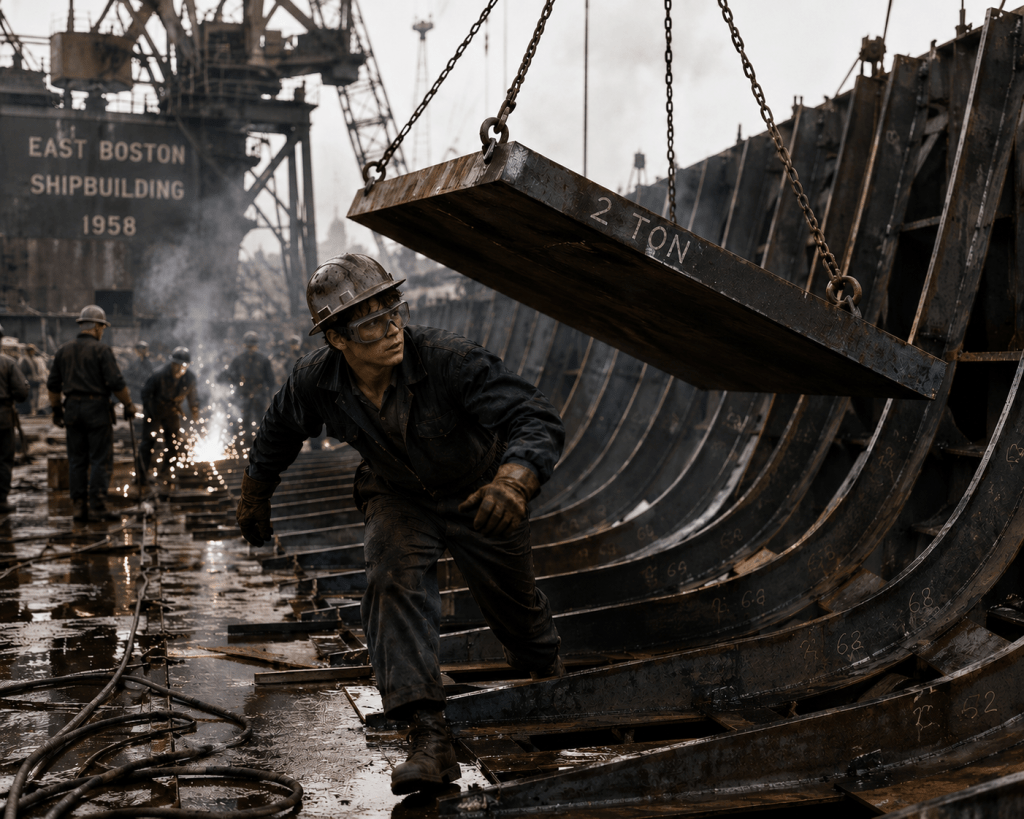
When I was sixteen years old in 1958, I worked in an East Boston shipyard. It was an environment of high-stakes, industrial-grade labor. I stood on the deck of a new hull with multi-ton overhead steel plates swinging into place, dodging the blinding glare of arc welding and the constant hiss of torch sparks.
I still carry a scar on my left hand from that jungle experience I describe in my autobiography, Path Perilous. It isn’t a blemish; it’s a badge of honor.
That early exposure to genuine risk and heavy production did something foundational to my psychology. It taught me an unshakeable respect for physical reality, sequence, and consequence. If you lost focus for ten seconds, someone got seriously hurt. It was impossible to sit around wondering if “anything matters” when you could see the physical manifestation of your sweat rigged into place at the end of every shift. That early hardship was building something more durable within me. It built the internal ballast required to navigate complex engineering projects in my career and life’s long-term catastrophic storms without flinching.
Today, millions of young men living in their parents’ basement drift through climate-controlled interiors, staring into glowing screens, never forced to test themselves against physical consequence. Many have never held a dangerous tool, built anything heavy, or depended on their own competence under pressure. Yet society still expects resilience from these same people it no longer initiates into harsh physical reality. Today’s youth are entirely cushioned from experiencing real stakes and frictional polish. And as a result, they lack the tough calluses—literal and metaphorical—to stand their ground when modern life gets rough.
Nature’s Brutal Remedy
History teaches us that when a nation’s youth lose their sharpness because life has been rendered effortless, then society becomes structurally fragile. Internal discipline atrophies, and the younger population channels its energy into trivial, hyper-sensitive internal squabbles. Philosophers label it The Paradox of Prosperity.
But the rest of the world does not stop being hungry, ambitious, or ruthless for basic survival needs.
When a society fails to intentionally challenge its youth on its own terms, as it tried to do in 1933 with FDR’s Civilian Conservation Corps (CCC) or JFK’s Peace Corps in 1961, war becomes the non-negotiable reality check.
War instantly demolishes the illusions built up by decades of luxury. In a high-stakes survival scenario, abstract grievances and digital echo chambers vanish overnight. Tribal rivalries and political clashes dissolve when faced with a common enemy. The 16-year-olds are thrust back onto the front lines and the harsh hazards of factory floors constructing tanks and guns because the alternative is total erasure.
But war is a catastrophic cure that burns down the hospital to save the patient. The great challenge of our time is to cheat this war cycle. We must design a voluntary crucible for maturity that manufactures the hardness, collective discipline, and absolute reality of a shipyard experience before comforts collapse in a war that forces a dystopian catastrophe.
The Historical Rhyme
In 1910, the philosopher William James warned that prosperous societies risk becoming spiritually and psychologically soft when hardship disappears from ordinary life. He proposed what he called a “moral equivalent of war” — an organized national discipline that could toughen character without the catastrophic destruction of actual conflict. Four years later, Europe descended into the trenches of World War I, where industrialized slaughter imposed its own brutal initiation upon an entire generation. William James gave us the blueprint over a century ago, and the scars of a global war proved what happens when we ignore it. We must give our young men a job to do, take them out into the field, and make them earn their keep. It’s time to bring back the shipyard scars. We can no longer rely on our softened, high-tech environment to build a toughened people. If we continue to coddle our youth in a prosperous limbo, we are simply abdicating our future to the next involuntary disaster.
How would you go about doing this?
https://www.theepochtimes.com/opinion/where-have-the-men-gone-6023982
If you’d like more insights, visit RMDellOrfanoAuthor.com under the blog categoriy … Autobiography where conscience, culture, and spirit intersect.
If you like what you read, please refer this website to others.
Published by the New Oxford Review, a conservative Roman Catholic peridodical
Richard M. DellOrfano spent ten years on a cross-country pilgrimage following Christ’s instruction to minister without possessions. He is completing his autobiography: Path Perilous, My Search for God and the Miraculous.


Leave a Reply