My parents were married for life.
The Catholic Church had little to do with it.
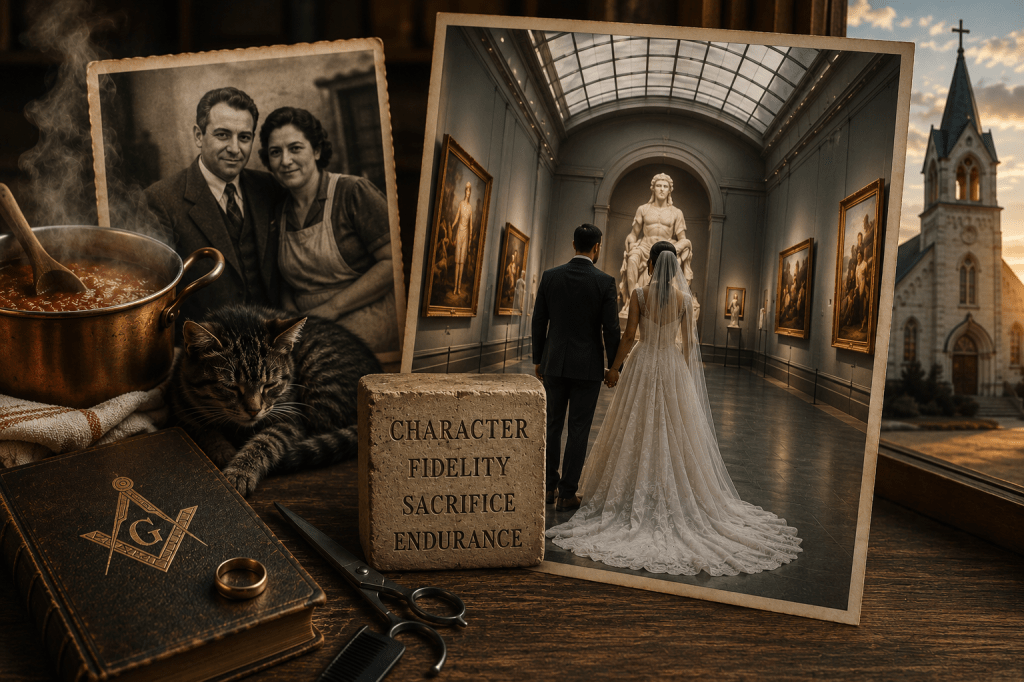
My father had become deeply suspicious of organized religion and turned instead to Freemasonry. He was the Worshipful Master of two separate lodges and reached the 32nd degree in the Scottish Rite. He was also a Shriner doing incredible philanthropic work. I often heard him pacing across our living room floor while he practiced aloud his lodge directives. He commanded enormous respect from our extended Italian-American family. When he spoke at family parties or business meetings, all chatter froze and time stopped.
My mother needed no lodge and no pulpit. Her kitchen was her sanctuary, filled with the scent of Sicilian seasonings in whatever exquisite cuisine simmered on her stove. She dispensed advice while serving our meals or cutting our hair. During a winter blizzard, she might spot through the kitchen window a stray cat yowling in hunger, then open the kitchen door despite freezing air rushing in, and feed it scraps. She had wanted to be a nurse. Merck’s Manual sat open by the phone when she advised sick relatives. She surgically removed a gross, wiggling octopus-like growth from my brother’s knee and held it up for our cautious inspection. Ours was a mother personifying grit and grace.
Neither of my parents pretended to be saints. They didn’t have to, for they knew how to persevere, to sacrifice, to remain faithful, and to put others first. Their marriage was a civil ceremony, not a sacramental marriage in the Catholic Church. Yet, their bond endured the ordinary stresses and strains that test a marriage. More important, we children learned how it worked firsthand. We didn’t learn about marriage from a Pre-Cana handbook.
Being the oldest of four siblings, my weak genetic constitution and sensitive nature may have contributed to my remaining single. My three younger siblings all married. Only one married in the Catholic Church. All three marriages remain solid and sound, a living testament, I think, to our parents’ shining example.
I received a mailing from one of my young relatives announcing that he was getting married to his beloved in a distant city museum, not a local church I could safely manage in old age. When I learned where the wedding would be, the Catholic traditionalist in me stirred an inward debate. Our family history backed my cousin’s decision for a civil marriage.
But a museum?
He was raised a staunch Catholic. Why step outside the parish walls for a city museum hall filled with only worldly historical artifacts and officiated by a parson?
Then this question came up. What exactly had sustained my parents all those years? It certainly wasn’t canonical paperwork. My father wanted little to do with the Church. My mother possessed a natural wisdom that needed no college degree or formal religious instruction. Yet together they built a sturdy household and taught four children how to honor marriage.
That provokes another uncomfortable question. What if young couples arrive at the altar without first learning from their parents’ example what permanent marriage demands? After a showering of material gifts—often without a proper thank-you—the church wedding will have its priest, vestments, altar, candles, music, and flowers—every canonical box properly checked. But can any ceremony bestow the character gifts of patience, fidelity, endurance, restraint, and the devout willingness to make that ultimate sacrifice when those virtues were never learned at home?
Our modern “Me-first” culture does young people no favors. We teach them to protect their choices, pursue personal fulfillment, and keep their options open with prenuptial agreements. Then we expect them to make a binding promise intended to survive the sicknesses, disappointments, financial troubles, temptations, all the aches and pains of aging, and the aggravations of living sixty or seventy years with the same human being.
My Depression-era parents had very little money and were not joined in a sacramental marriage. What they possessed were strong character traits forged and tempered by the Great Depression. They passed enough of them to their children, so three marriages could endure. Whatever else they lacked in formal religion, they modeled cardinal virtues.
None of this realization leaves me indifferent to sacramental marriage. I believe the altar matters in incomprehensible ways. But traditional Catholics can spend a lot of time examining the doctrinal architecture of a marriage while forgetting to assess the personal character of the two people at the altar, promising a lifetime together.
My cousin chose a museum. I hope he carried through its doors the quiet discipline of my father, the fierce tenderness of my mother, and the knowledge that true love becomes a sustainable covenant if married couples learn the meaning of total sacrifice.
See: “Why Are So Many Couples Getting Married Outside the Church?” — Deacon Greg Kandra, The Deacon’s Bench, Patheos.
Richard M. Dell’Orfano spent ten years on a cross-country pilgrimage following Christ’s instruction to minister without possessions. He is completing his autobiography:
Path Perilous, My Search for God and the Miraculous.
Leave a comment.
.


Leave a Reply